Trucking Needs More Than a Choice Between Diesel and EV Trucks. Electrify the Trailer.
October 26, 2026
Fleets need the most fuel savings for every dollar invested, with equipment that fits their operations. Range delivers that by putting a powertrain on the trailer, with no need to replace the tractor.
State of the Industry
Diesel prices are at record highs. Refrigerated fleets are especially pressured as they burn diesel from two engines: the tractor’s and the reefer’s (the transport refrigeration unit, or TRU, on the front of the trailer). Electrification of the heavy-duty truck sector, replacing diesel trucks with electric vehicles (EVs), has proven challenging in North America. The Tesla Semi is poised to disrupt the industry, provided it can deliver the cost savings and operational fit that fleets need to move off the “status quo” of staying with diesel tractors. Expanding electrical infrastructure and installing chargers is well known to be the biggest challenge in the rollout of all EV deployments.
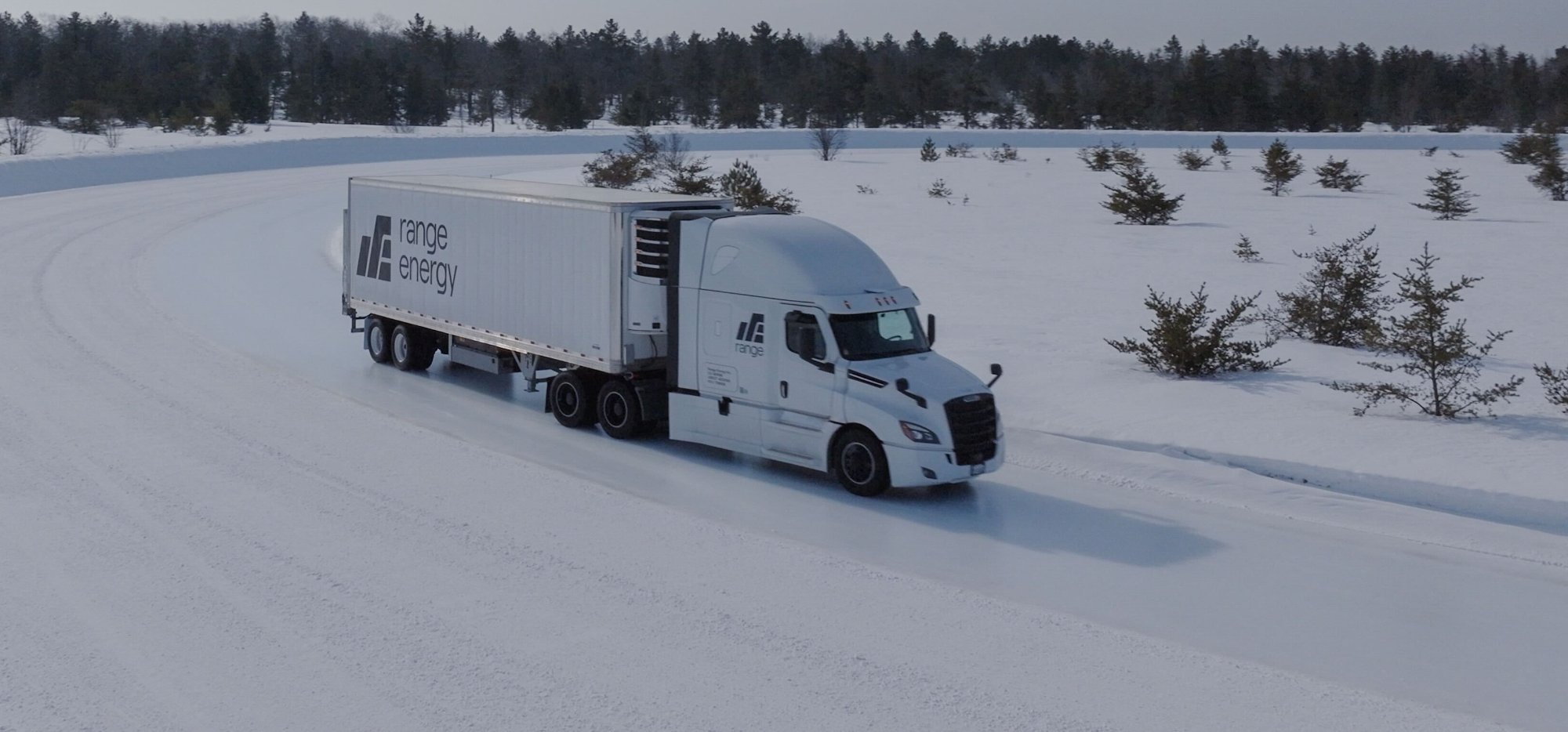
Range Energy is bringing a new choice to the industry with its eTrailer system, which adds a battery and electric axle to the trailers a fleet already owns, allowing fleets to save diesel on both engines without replacing their tractors or trailers.
Purpose of this Paper
To evaluate options for fleet owners, Range Energy created a model comparing different ways to cut diesel use. Because long-term predictions are uncertain, the model uses the Monte Carlo method, a tool that runs many randomized scenarios across the key factors. Testing a wide range of economic situations helps reduce the impact of individual assumptions and gives a clearer picture of the potential financial outcomes.
The evaluated options are: do nothing, purchase an electric tractor, or purchase a Range eTrailer. Until recently, most fleets chose to do nothing; record diesel prices are making them look again. The Tesla Semi is the EV case study because it has the most detailed available cost, specification, and performance data, and offers a compelling return on investment against the baseline diesel tractor.
The analysis is produced by Range Energy’s engineering team, so we have a stake in the result. We have tried to temper that bias and be as fair as possible when comparing two very different approaches to reducing diesel consumption. The main comparison points are:
- Upfront capital for the units and their supporting charging
- Projected diesel reductions
- Ongoing fleet operating expenses including electricity
This paper focuses on Range’s primary early adopter market: grocery and foodservice refrigerated fleets, which mostly run regional routes that return to base each night.
Executive Summary
Much of the discussion focuses on the decision a fleet can make today: to start building out charging infrastructure (which can be a multi-year endeavor) and get in the queue for a Tesla Semi, or to put in orders for a Range eTrailer, which starts serial production in late 2027.
Even under conservative modeling across various potential scenarios, the financial analysis shows a virtual tie between the eTrailer and the Semi in terms of overall value for the fleet. That is with diesel held at $5.07 a gallon and no incentives; at September’s national average (about $6.50) both options pay back in about four years and beat staying with diesel in nearly every future. The Range eTrailer is the option for fleets that requires less upfront capital and minimal disturbance to how they operate today.
The Options: Range eTrailer vs. Tesla Semi
Range eTrailer
The Range eTrailer system is a battery and an eAxle fitted to a refrigerated (as well as non-refrigerated) trailer the fleet already owns, with a 200 or 300 kilowatt-hour (kWh) pack. The 300 kWh eTrailer has launch pricing of approximately $100,000, including the 44 kilowatt (kW) alternating current (AC) charger, and production deliveries begin late 2027. The eTrailer can hitch up to any tractor with no modifications, data connection or special driver training: it accelerates like an empty trailer even when fully loaded, with more stability from regenerative braking on the trailer.
The eTrailer saves diesel on two engines. The eAxle helps the trailer pull its own weight, so the tractor burns about 36% less diesel, and the trailer recovers energy under braking, reducing brake wear and further improving efficiency. The reefer runs from the battery on the road and can still run on electricity when the eTrailer is plugged into a charger in the yard, so the reefer’s diesel engine stays off. Fleets with electric-standby plugs rarely use them, because the existing pin-and-sleeve plugs are inconvenient, so the typical reefer often idles on diesel at the dock or in the yard.
Tesla Semi
The Tesla Semi is a Class 8 day cab tractor, with a Standard Range and a Long Range variant.
- Standard Range: reported battery size 548 kWh2; driving range up to 325 mi3; reported cost $260,0004.
- Long Range: reported battery size 822 kWh2; driving range up to 500 mi3; reported cost $290,0004.
Tesla offers two charging options, the 120 kW Basecharger and a 1.2 MW Megacharger3. Their trade-offs are discussed below.
The Semi could cover the reefer engine too. It comes equipped with a 25 kW electric power take-off (ePTO3), an outlet that powers equipment from the truck’s battery. It does require a mating connector on any coupled trailer, which no reefer manufacturer offers yet, and every trailer would need one to use the Semi’s electric power. Running the reefer would spend about 55 miles of the truck’s range per day (highly dependent on weather and refrigeration setpoint), enough that the Standard Range would struggle to comfortably complete a 250-mile route, so a customer using the ePTO is more likely to purchase the Long Range truck, shifting their payback out for range they rarely use.
What Fleets Want: Diesel Savings and a Lower Cost per Mile
When evaluating ways to reduce their fuel bill, fleet owners must first consider the yield on each invested dollar. This section measures the total diesel reduction across seven years of service, normalized per $1,000 of capital expenditure before incentives. Capital here means the equipment cost beyond a standard diesel tractor replacement, including installing the required charging.
Because charging infrastructure represents a substantial portion of any electric vehicle deployment, the charts below outline various configurations for the Semi, given its wide range of setup possibilities. On a capital-efficiency basis, the two highest-performing Semi configurations surpass the eTrailer; however, one sacrifices operational adaptability while the other incurs higher recurring operating expenses. Two tractors on one Basecharger is a planning case of our own, included here as a scenario a fleet may evaluate to maximize capital efficiency. Additional details and analysis are available in the Charging & Infrastructure Costs section.

Per vehicle, the Semi avoids more diesel, because it replaces the tractor’s engine outright. It burns no diesel on any mile it drives, while the eTrailer trims the tractor’s fuel by more than a third on the miles its pack covers and keeps the reefer running 100% electric on the vast majority of routes. Counting both engines, the eTrailer avoids over half (54%) of the diesel the tractor and reefer burn today, and the Semi about 70%. That gap largely closes when we look at savings per dollar instead of per vehicle.
Trade-offs between Capital Expenditures (CAPEX) and Operational Expenses (OPEX)
Per dollar invested, the two are remarkably close: the eTrailer avoids 387 gallons per $1,000, against 358 for a Semi with its own Basecharger (Tesla’s depot charger). The Semi’s per-vehicle savings come with a bigger bill, for the truck’s premium over a diesel tractor and for a charger sized for a truck.
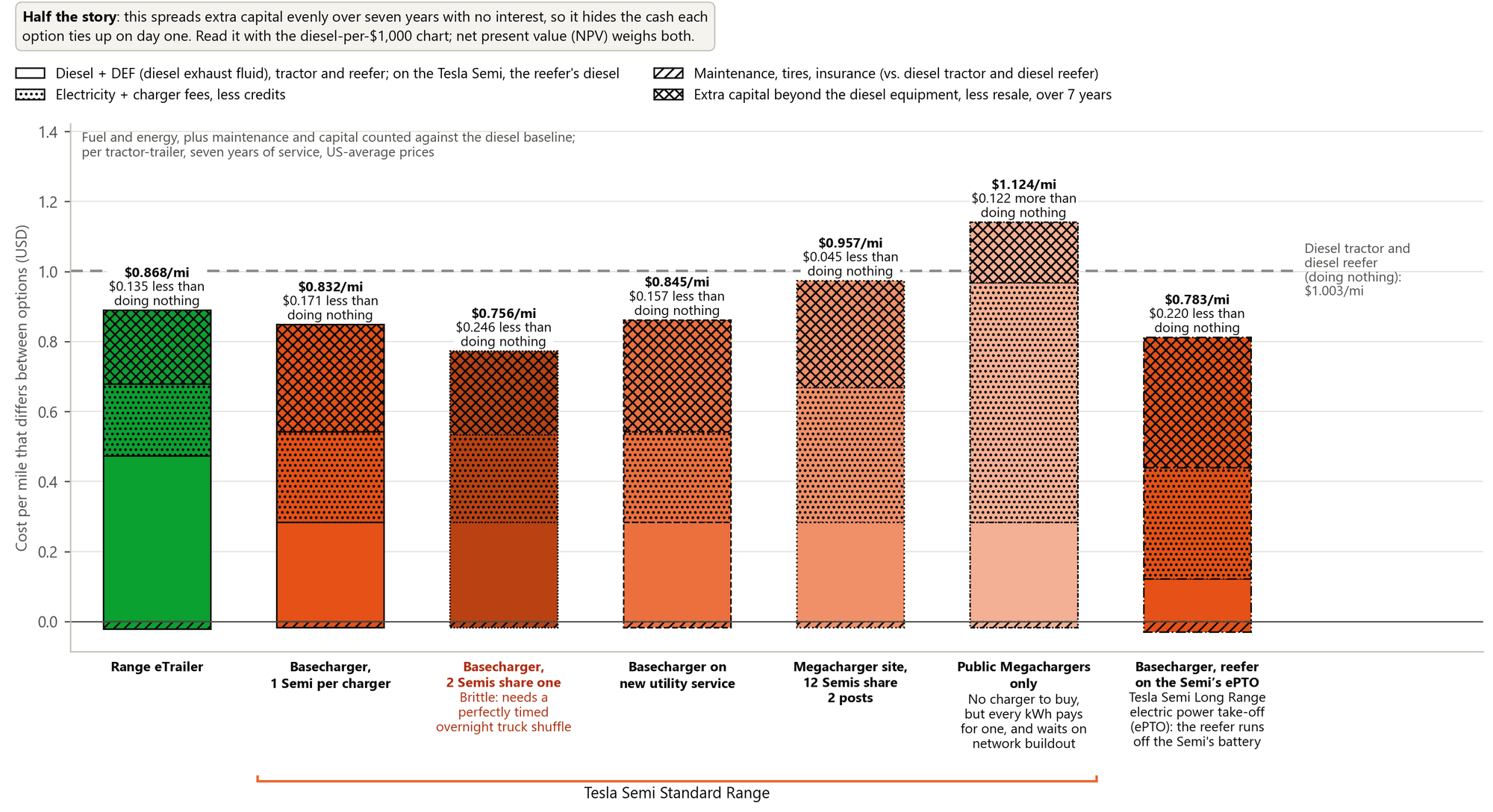
The other side of spending is operating expense, which means cost per mile. The baseline case is today’s diesel tractor and diesel reefer. This analysis excludes driver wages, since they are the same for every option. The Range eTrailer and Tesla Semi (with different charging alternatives) stack up their electricity costs, remaining diesel costs, amortization of incremental purchase costs, and other incremental costs (maintenance, tires, insurance). At US-average prices both cost less a mile than doing nothing: $0.87 for the eTrailer and $0.83 for a Semi with its own Basecharger, against $1.00 for sticking with diesel. A Semi that pays the demand charges of a Megacharger (Tesla’s fast charger) or public charging prices gives most or all of those capital savings back.
The cost per mile figures in this graph are oversimplified, especially for the charging infrastructure: they only include the baseline cost assumptions. Additionally, this bar chart doesn’t incorporate the time value of money punishing upfront expenditures. The Monte Carlo analysis in Figures 6 to 8 shows that uncertain charging-infrastructure costs frequently land higher than shown here. Across the 1,000 sampled futures the median cost per mile rises from $0.83 to $0.86 for a Semi with its own Basecharger.
Charging & Infrastructure Costs
The charging infrastructure costs included above weigh heavily on both the capital spending and the cost per mile, through what each delivered kWh really costs. Charging is known to be one of the largest unknowns and challenges in the electrification space, and Range’s approach is simpler and more flexible.
Charging the eTrailer. The Range eTrailer is capable of 150 kW direct current (DC) charging through a CCS1 connector, but the recommended charging method is via the 44 kW on-board charger, which uses a Society of Automotive Engineers (SAE) J3068 connector: the standard for charging heavy vehicles on AC from a 480-volt, three-phase circuit. As with a passenger car’s AC wallbox, the power electronics live on the vehicle, so the equipment at the dock stays simple. The eTRUconnect EV+ station from ESL Power Systems is included with every eTrailer purchase: a safety-interlocked station that feeds a J3068 outlet from a single 480 VAC three-phase circuit, rated to 52 kW, which can flow to the reefer and on-board charger.
The same station also provides backward compatibility for shore power reefers through a standard IEC 60309 outlet, so one installed at a dock serves whichever trailer is parked there: a Range eTrailer or a conventional electric-standby reefer. Most refrigerated warehouses already have this power available, especially if they already run electric-standby reefers. If the power isn’t yet in the right spot, getting the circuit installed typically costs anywhere from $4,500 to $23,200 depending on location and complexity, about $5,200 at a typical dock.
The Semi’s charging options. The Semi requires the Megawatt Charging System (MCS) connector and has two power level charger options. It has no backup charging option, so it must have access to an MCS charger. In many ways how it gets charged decides its economics, so the multiple options are compared below:
- Basecharger: 120 kW3. Charging time (10–90% estimate): Standard Range 4 hr, Long Range 6 hr. Trucks per installed charger: 1, or 2 with tight timing for overnight charge sessions. Hardware: $20k per post3. Estimated install lead time: 1–6 months.
- Megacharger: 1,200 kW or 1.2 MW (megawatts)3. Charging time (10–90% estimate): both sizes 35–45 min. Trucks per installed charger: 4 to 6. Hardware: $188k (one charger, two posts)3, and likely a Megapack, about $1M. Estimated install lead time: 1–5 years5.
- Tesla-owned or public Megacharger: 1,200 kW (1.2 MW)3. Charging time: both sizes 60% in 30 min3. Shared with other fleets. Hardware: none to the fleet, but substantially higher energy costs ($0.35 to $0.55 a kWh6). Lead time: route dependent.
Hardware for each Basecharger post runs $20,000, with installation adding a median $31,500 (covering trenching, electrical work, pad construction, bollards, permitting, and commissioning) to reach $51,500 in total capital. Using the same unit costs, the eTrailer’s circuit costs about $5,200 at a standard dock, and up to $23,200 for a fully trenched yard pedestal.
Sharing a Basecharger is the Semi’s most favorable option, and the most comparable to the Range eTrailer’s charging installation costs. Each Standard Range Semi needs three to five hours on a 120 kW Basecharger, depending on how much of the battery the route used. Two of them sharing one charger just barely fit in a 10-hour night, depending on shift timing, and two Long Range Semis definitely do not fit within a 10-hour night. Due to Hours of Service (HOS) limitations, a typical 24-hour period is divided into a 14-hour “on-duty/driving” period with a minimum 10-hour consecutive “off duty” period before a driver can continue the next day. A full 14-hour shift followed by a full 10 hours for charging leaves zero margin at the start of the next day.
Power is the other limit. A typical depot’s spare power could handle about 3 Semis on their own Basechargers before the site needs new utility service, which the model puts at 24 months5; the same power carries about 8 eTrailers.
Most installations of the Megacharger end up more expensive in the long run. A fleet either ends up paying higher demand charges to its utility7 or needs to also purchase Tesla Megapacks, stationary storage batteries that buffer charging with cheaper grid energy stored earlier in the day at lower electricity rates. There are complex strategies to benefit from the cheapest daily grid energy, but their payback is typically longer than the life of the vehicles we’re discussing, and they require sophisticated energy management tools to execute, so they are generally a net negative.
Regardless of the option, the 44 kW, 480 VAC chargers required for the Range eTrailer should be quicker, easier and less expensive to install than any required by the Semi.

Public chargers or Tesla-owned Megachargers are an additional option that requires no capital spend for the fleet, but comes at substantially higher OPEX costs. Those charging locations are a sparse option at the moment; the networks are growing, but it will take years. Tesla is currently planning 66 sites in 15 states8: a start, but still very sparse for trucking fleets nationwide. If truck chargers spread as fast as Tesla’s passenger car Superchargers did, one won’t be within reach on most freight routes until early 2032 at the soonest, and more likely 2033 to 2036. Unlike consumer Superchargers popping up in parking lots, truck sites need pull-through bays near highways and warehouses - the land acquisition for the truck charger locations will be challenging. As another economic headwind, the high-power infrastructure, utility capacity, and energy supply for highway-side charging are competing directly with the AI data center buildout. Trucking fleets cannot financially compete with hyperscalers for access to similar electrical infrastructure upgrades.
Modeled Performance and Assumptions
This analysis focuses on refrigerated foodservice and distribution fleets using a representative data set that Range has collected from real-world eTrailer operations hauling cargo for a variety of fleets, which can be used to compare the Tesla Semi and the eTrailer on the same kind of work.
What the model compares. It follows one tractor and one refrigerated trailer, one shift per day and 250 days a year, through seven years of service for each option, and compares it against continuing business as usual with diesel tractors and reefers. Seven years is used as a comparable replacement date for diesel tractors, which allows for a comparison against “sticking with diesel”. Each option’s seven years run from the month it starts earning, properly accounting for the time between now and when the technology is delivered.
The decision. The financial results are for a fleet deciding on deliveries of new fleet assets in late 2027, when eTrailer deliveries begin and a Semi and trailer ordered today could be delivered. That way neither the eTrailer’s production lead time nor the Semi charger’s lead time impacts the result. A Basecharger is live the day the Semi arrives, and the eTrailer’s charging circuit is ready the day its kit arrives. A Semi site that needs new utility service still waits about a year.
The tractor. The Semi replaces a diesel tractor that is due for replacement anyway, so its capital expenditure includes only costs beyond the $165,000 diesel tractor the fleet would have otherwise bought. It isn’t financially viable to replace diesel tractors before they’re due for replacement, so a fleet will take years to replace diesel tractors with Tesla Semis. The eTrailer goes on a trailer the fleet already owns either way.
Prices. US-average: diesel at $5.07 a gallon (the US Energy Information Administration’s 2026 forecast, held into late 2027) and depot electricity at $0.13 a kWh. Important consideration: recent national averages crested above $6.50 a gallon in September 2026. This doesn’t include a bulk discount or commodities hedging, but the sensitivity sweeps in the Monte Carlo analysis cover the anticipated spread of discounts by a wide margin. Every depot charger also carries its own upkeep, 0 to 10% of its hardware price a year: about $1,000 for a $20,000 Basecharger and $250 for the eTrailer’s $5,000 charger9. Tesla’s $0.08-a-kWh service fee applies to sites that charge outside trucks for revenue3, so a fleet’s own Basecharger pays no per-kWh fee here. Charging overnight usually sits under a depot’s daytime peak; the futures allow demand charges of up to $0.03 a kWh for both options’ chargers. Reefer (red) diesel is priced net of the federal road tax a fleet can recover on fuel for a separate reefer engine ($0.243 a gallon)10, drawn down to $0 for fleets that don’t claim it. Running the reefer electric also avoids most of its engine’s upkeep, about $1,150 a year at base ($600 to $1,575)12,13, counted for every hour the reefer runs electric, on the eTrailer or on a Semi carrying its reefer on the ePTO.
Futures, not forecasts. Many inputs are uncertain: diesel and electricity prices, what a charger costs to install, both vehicles’ insurance, tires and resale value, what their chargers cost to maintain, and how much the eTrailer saves on a given fleet’s routes. The Monte Carlo analysis draws each one from its range, 1,000 times, and each draw is one plausible future that both options share, so they are compared like for like. The eTrailer’s performance in each future comes from one pilot fleet’s logged days. Results are read as the share of futures in which one option comes out ahead: a share of plausible inputs, not a forecast.
The Standard Range Semi. For the majority of this analysis, the Standard Range Semi is the comparison, because it covers the typical regional day and is the version a regional fleet would buy. While the Long Range can run longer routes, it costs more and takes longer to charge, making 120 kW charging less viable. The Long Range appears only where route distance is the question.
Assumed Tesla Semi performance. The model uses Tesla’s published figures, 1.7 kWh a mile loaded3 and the battery sizes above, with the same 10% operating floor the eTrailer stops at; both packs are modeled as losing 2% of their capacity a year. That gives the Standard Range about 290 miles of dependable range when new and 250 after seven years. A reefer on the ePTO, drawing the dataset reefers’ average 11.2 kW on the road, takes about 90 kWh a day from the truck’s battery: the 55 miles of range mentioned above. About half the pilot’s refrigerated days (49%) would then run beyond a seven-year-old Standard Range, which is why a fleet running its reefer from the Semi needs the Long Range.
Range eTrailer Demonstrated Pilot Performance
For the past two years Range Energy has been running pilots with prototype eTrailers, learning the many ways in which every fleet is different. Learnings from these pilots influenced the development of the production Range eTrailer, and the pilots also gathered real-world data with the eTrailer hauling cargo for a variety of fleets with their normal trucks and drivers. Comparing the fuel economy during those pilots to the fleets’ own baseline data quantifies the percent reduction in tractor fuel consumption achieved by the Range eTrailer. An earlier independent test by MVT Solutions11, on a less-performant alpha prototype with a smaller motor, measured 36.3% better fuel economy on its test loop (about 27% less fuel); Range has since followed the same industry test standards in its own testing.
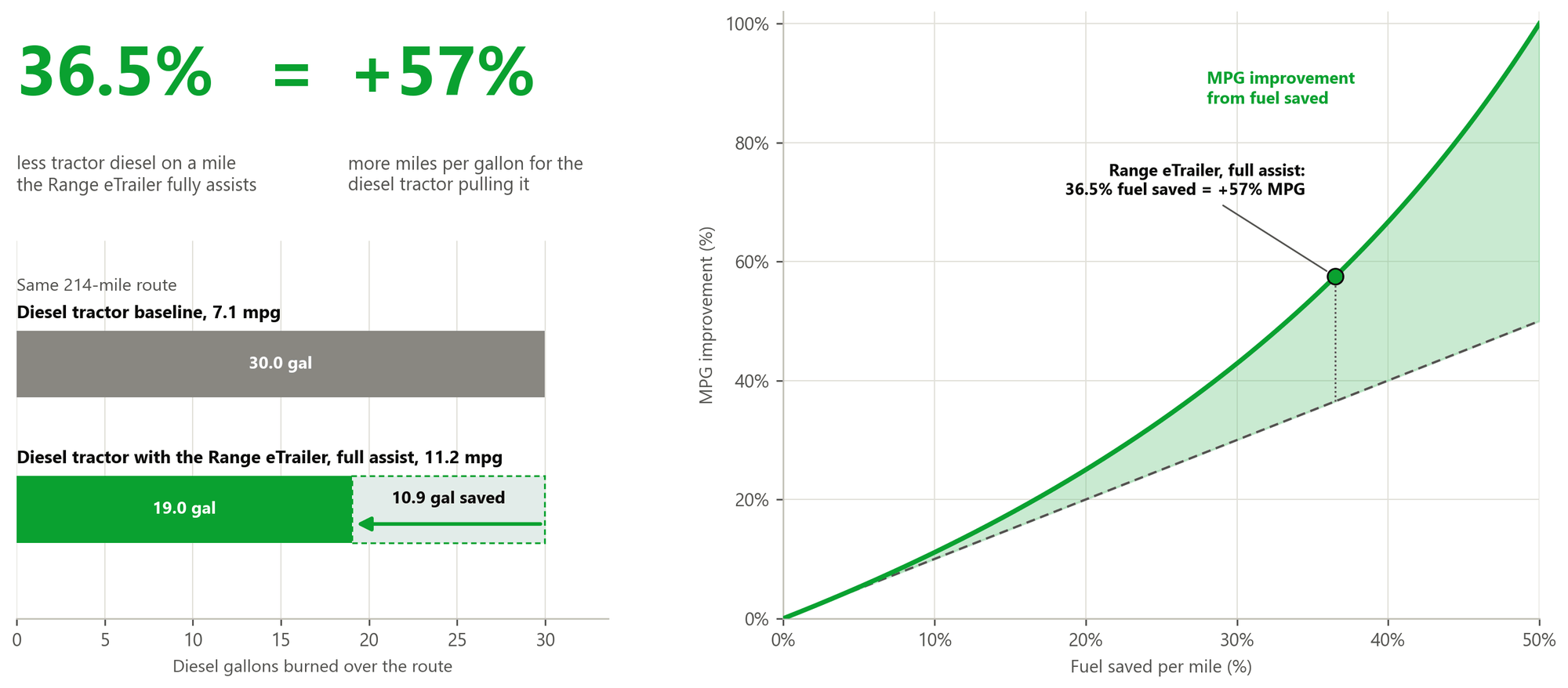
A quick note on percentages: fuel saved is not the same as miles per gallon (mpg) gained. The model’s base, calibrated on the pilot days, has the tractor burning 36.5% less fuel on each mile the eTrailer assists, which is equal to about 57% more miles per gallon. A common misconception is that fuel-savings-to-mpg is a 1:1 relationship, which is only close for small improvements in fuel economy (under about 7%). A visual of this discrepancy is provided below for illustrative purposes:
The Range eTrailer can assist the tractor’s engine for 200 to 250 miles while also supporting the reefer with electric power. This can be quite variable depending on the route and the refrigeration demands (setpoint and weather conditions). After that range is exceeded, as the battery floats around 10% state of charge, the trailer continues to use regenerative braking on every stop, and uses that recaptured energy to keep running the reefer and helping with accelerations. This means the eTrailer effectively has unlimited range support - if any electric tractor runs empty on a route, it’s stuck.
During the pilots, normal delivery driving recovered enough braking energy to run the reefer outright on 48% of logged days, and at least half of what it needed on 75%; the reefer’s diesel engine turns on as a fall-back to avoid load loss when the battery still runs short.
The plot below shows the fuel savings performance from the real pilot days, overlaid with the simulated savings. A reduced set of pilot days is used for this comparison, based on a few filters:
- The availability of high-quality baseline fuel consumption data (statistically significant, fleet-tracked for similar tractors)
- Dropping the days when a battery-electric tractor pulled the eTrailer (to extend that tractor’s shorter range) instead of a diesel tractor
- Dropping dry-van pilot days from the dataset, as these lack reefer energy consumption
Out of 83 refrigerated pilot days, that leaves 43 days from 6 fleets. The orange shows where a Tesla Semi would run out of range and require a mid-route charge or a change to shorten the planned route. Days within the eTrailer’s assist range save the highest percentage: the median such day saved 36.5% of the tractor’s fuel, against about a quarter for the longer days. But the eTrailer saves about the same gallons whether the day runs 200 miles or 649; past its range, the percentage falls only because the day’s total fuel keeps growing. No EV tractor could do a 649-mile route without a well-timed and conveniently located Megacharger to charge during the day (preferably during the driver’s required 30-minute break). It is theoretically possible in some limited cases, but logistically challenging, with little margin for surprises along the route. Of these 43 pilot days, 26% of the routes in this dataset would not be achievable with the Standard Range Tesla Semi with its reefer on the ePTO.

The variability is somewhat misleading: the percentages are based on each day’s fuel economy against a fleet average. Individual routes will vary greatly based on the city and highway split, hills and so on, and against that static average baseline, the route itself is what makes the percentages swing so widely.
Flexibility: the eTrailer fits the way fleets run
A driver’s day starts with a plan, and when plans change, the eTrailer is built for that.
- Forgot to charge? The route still runs. The eTrailer works as a standard trailer, and the reefer falls back to its diesel engine if the battery falls low enough. Cooperative regenerative braking is still available to help power the reefer.
- A last-minute backhaul (a load for the return trip), or a longer day? Keep trucking. Once the pack is spent, the tractor’s diesel carries on as it always has; swing by a truck stop if you need more fuel.
- A load that has to stay cold for days without warning? Trucking can be chaotic. The eTrailer handles it automatically, leaning on the reefer’s diesel engine as a backup.
- Liftgates and other powered systems. The pack also powers the liftgate and the trailer’s other powered systems, cutting downtime.
- The reefer’s power belongs to the trailer. It stays powered in the yard after the tractor leaves, and it never spends the truck’s range (projected impact of 55 mi or more).
- Longer days. Of the 83 total days in refrigerated pilot service, 23% ran beyond the Standard Range Semi’s range when new. That range is 290 miles, keeping a 10% operating floor, since no fleet plans for a truck to roll back into the yard at 0%. The list below shows the compounding reductions of driving range from other effects, and which routes it would fall short on.
Tesla Semi Standard Range: share of pilot days beyond each range (of the 83 refrigerated pilot days / of the 43 days with a fleet baseline):
- Rated range, new (325 mi): 17% / 21%
- Dependable range when new, 10% floor (290 mi): 23% / 26%
- Dependable range after seven years (250 mi): 28% / 26%
- Rated range, reefer on the ePTO (about 272 mi): 25% / 26%
- After seven years, reefer on the ePTO (about 184 mi): 49% / 37%
None of the above are priced in the financial results that follow. As will become clear below, no fleet of this profile would plan to charge exclusively at public Megachargers: in our model, doing so costs $0.12 a mile more than staying with diesel and comes out ahead of diesel in only 1% of futures. Yet Tesla and others are building them anyway, because a truck that can recharge on the road can handle the long day and the unplanned load. That tells us what flexibility is worth to fleets. The eTrailer gets the same flexibility from the diesel tractor and the truck stops that already exist, at no extra cost and with no wait for a network to be built.
The Money: Payback and Net Present Value
Net Present Value (NPV) is a financial analysis tool that translates a project’s total financial performance into today’s dollars. It does this by combining upfront investments and ongoing operational savings earned at a future date.
Because of inflation and the opportunity cost of capital, money saved or spent in the future is worth less than money spent today. A positive NPV indicates that an investment generates a net financial gain over time compared to sticking with the status quo.
Operating cost per mile covers the costs that differ between the options:
- Diesel and DEF (diesel exhaust fluid, an additive for the exhaust aftertreatment)
- Electricity and charger fees, less any clean-fuel credit
- Maintenance, tire and insurance differences
- The capital, less incentives and resale, written off evenly over seven years
To reflect the time value of money, NPV incorporates a discount rate that reduces the present value of future operating savings. While the baseline model applies a 9% annual discount rate (typical for fleets financing equipment), individual simulated scenarios draw rates between 6% and 12% to capture economic uncertainty. At the 6% rate representative of larger fleets, both choices yield higher overall value and the gap between options closes; conversely, under a 12% rate, both options drop below break-even in baseline conditions, favoring the eTrailer option with its lower initial capital demands.
Payback period represents the time needed for operating savings per mile to fully recover the upfront capital expense. The accompanying chart illustrates this cash flow over time, showing the size of initial investments alongside ongoing savings. Shaded bands display the distribution of outcomes across simulated futures for both the eTrailer and a Semi using a dedicated Basecharger, representing primary deployment scenarios.

In the base case the two are close: the eTrailer’s NPV is +$7,200 and it pays back in 5.6 years, while a Semi with its own Basecharger reads +$4,500 and 5.7 years. Across the 1,000 sampled futures the gap widens: the eTrailer’s median is +$7,900 against +$1,000 for the Semi, because the Semi’s uncertain infrastructure costs more often pull its result below its own base case, while the eTrailer’s result mostly follows the price of diesel.
NPV is used to boil down a capital and operating budget trade-off to a single number. Positive is good, generating value for the company, while negative generally indicates a net loss on the capital. The Monte Carlo analysis can sweep all the variables and compare the NPV of a fleet’s choice to buy a Semi or an eTrailer. Plotting them against each other, the two are close, with the eTrailer ahead in 61% of futures against a Semi with its own Basecharger. Against the Semi’s most favorable charging configuration, two trucks sharing one Basecharger, it flips: the Tesla option comes out ahead in 87% of futures, but that Semi configuration is operationally difficult as noted previously. You can also see that the eTrailer’s NPV is positive in 66% of futures, and most of the rest are futures where diesel falls below today’s price projections. The Semi with its own Basecharger is positive in 51% of the simulated scenarios: diesel price matters for it too, but so do its charger’s installation and hardware, demand charges and its resale.

The full spread of charging options is captured here, showing the full distribution across the Monte Carlo simulated scenarios. The eTrailer’s spread is narrower, because its result mostly follows the price of diesel. The Semi’s spread depends on how it charges: positive in 86% of futures with two trucks sharing a Basecharger, down to 1% on public chargers alone. The scatter plot above compares Figure 8’s first row to the second with the same scenario for each.

Where these results are conservative. The results are deliberately careful about electrification. The base case for diesel is held at $5.07 a gallon, while the Monte Carlo spreads below the optimistic futures market's $4.40 for 2027 and up to the $6.53 record of September 2026. At September’s US-average prices, both options would be worth far more: the eTrailer about +$50,000, positive in every sampled future, with a 3.8-year payback, and the Semi about +$61,000 and 4.0 years. At September’s prices in California, both are under 3 years - these cases are beyond the high side captured in this analysis. No purchase incentive or clean-fuel credit is counted in these spreads. Nothing is counted for what the eTrailer's pack can do off the road: powering liftgates and dock equipment, or serving as mobile or backup power. Its fuel saving is the pilot's, on prototype hardware, and the Semi's insurance and tire costs are set below the figures in a trucking association's draft calculator6.
The Other Half of the Electric Equation
The eTrailer and EV tractors don’t have to be competing choices - today the eTrailer can extend the range of any EV tractor towing it by at least 100 miles. Range is also provisioning for a future smaller-battery eTrailer option built for this pairing, focusing on powering the reefer and recapturing braking energy on the trailer’s axles where the specific fleet or route doesn’t need the range extension of our current offering. The reefer no longer depends on an ePTO connector or spends any of the truck’s range. This pairing is not included in the financial results above: it is further down the product roadmap, for when more fleets are running EV tractors with sufficient range to cover their routes.
Incentives
As the NPV spreads show, there are still scenarios where fleets can convince themselves that doing nothing is potentially worthwhile. All existing purchase incentives support EV tractors, and most were sized for the last few years, when the price difference between electric and diesel tractors was more extreme.
The active programs today pay for the truck, and only in a few states. California’s Clean Fuel Reward (CCFR) pays $120,000 toward a battery-electric Class 8 truck, opening in short funding windows. California’s Hybrid and Zero-Emission Truck and Bus Voucher Incentive Project (HVIP) pays another $120,000 but is closed for now, aiming to reopen by the end of 2026; Tesla Semis made up 965 of the 1,067 applications in its last window14. Washington’s zero-emission truck voucher program (WAZIP) pays $175,000 and is open, first come, first served. The federal truck and charger tax credits have both ended, and California’s utility charger rebates are closed at its two largest utilities. Clean-fuel credit programs in California, Oregon and Washington pay for electricity that replaces diesel: the Semi earns them on every kWh it charges at its depot, the eTrailer only on its reefer’s energy. The eTrailer currently* has no purchase incentive in the United States. Current incentive regulations focus narrowly on specific technology solutions (e.g. EV tractors) rather than broader emission-reduction goals. Consequently, the refrigerated eTrailer receives 0% of available incentive funds in the United States despite avoiding about three quarters (76%) of the diesel a Tesla Semi avoids.
Where these programs pay, they decide the result. In California the truck voucher alone is bigger than the gap between the Semi’s price and a diesel tractor’s. A moderately sized incentive for eTrailers could substantially improve their NPV and payback, ensuring more fleets have an alternative to pure EV adoption and accelerating the reductions in diesel consumption, and the associated emissions, that many regulators want. In fact, the Range eTrailer was recently admitted to Quebec’s Programme Écocamionnage, where it qualifies for a $50,000 CAD incentive1 for dry vans and refrigerated trailers. We look forward to working with various regulators on inclusion of our technology in more programs.
Limitations of this Analysis
Every model makes simplifications, and this one leaves out several things a fleet should weigh for itself:
- What the model leaves out. Emissions, income tax and financing terms (every figure assumes a cash purchase, before tax; the discount rate stands in for the cost of capital: 9% at base, drawn from 6% to 12% across the futures). Other electric and natural-gas tractors on the market aren’t considered. Payload is also left out: store-delivery reefer loads nearly always fill the trailer’s space (“cube out”) before its weight limit (the heaviest refrigerated pilot load was 35,000 lb), so the added weight of either option rarely costs a fleet any freight.
- Flexibility is not in the dollars. Missed charges, backhauls, and last-minute route extensions are not priced for either option. They mostly cost the Semi, so the financial comparison leaves out what the eTrailer does best.
- The pilot is small. The fuel comparison rests on a subset of only 43 pilot days, on prototype hardware. Each baseline is a fleet-reported average rather than a route matched control. The reefer’s diesel burn is an engineering estimate, because reefer fuel consumption is only ever measured in aggregate.
- The yard savings depend on today’s habits. The eTrailer’s savings in the yard assume the fleet’s reefers idle on diesel at the dock today, as most do; a fleet that already plugs its reefers in would save less.
- Tesla’s figures are public, not measured. The Semi’s prices are press-reported rather than list prices, its energy use and range are Tesla’s published figures, and its resale, insurance and tire costs are industry estimates for a truck with little service history. We set the Semi’s insurance and tire costs below the figures in a trucking association’s draft calculator6, which is built for long-haul duty.
- Safety benefits and insurance. Tractor safety systems, on a diesel tractor or a Semi, can only act through the tractor, and the Semi’s are comparable to those on today’s diesel tractors, so it carries no safety discount: about $1,500 a year more than a diesel tractor at base ($0 to $3,000). The eTrailer introduces novel safety benefits, using regenerative braking to improve braking performance and automatically steady itself: keeping the combination stretched out during dynamic maneuvers, which works directly against jackknifing15. Its insurance therefore ranges from a $1,000-a-year discount for that safety to a $1,500 increase for the roughly $100,000 of added equipment, with $500 a year more than today at base. No insurer has quoted either vehicle.
- Charging costs are site-specific. Installation, utility upgrades and lead times vary widely by site and utility. The model uses published prices for the chargers themselves and Range’s own bottom-up installation estimates, built from the same unit costs for both options; a given depot can fall outside them, for either option.
- Incentives are not in the results. Every result is at US-average prices, with no purchase incentive or clean-fuel credit for either option. Where programs pay, as in California and Washington today, they can decide the result, and they open, run out, and close frequently.
- One shift a day. A fleet running double shifts would see different charging limits and different savings.
Conclusion
The Tesla Semi is a great vehicle and an effective tractor for fleets that can manage to charge it cheaply. The Range eTrailer system takes a very different approach, and achieves fleets’ goal of reducing exposure to diesel price swings with less capital expenditure, less infrastructure, and a comparable return on investment. Against a Semi on its own Basecharger, both electrification pathways provide fleets with comparable value across the set of potential futures. Only the Range eTrailer works with all fleets the way they run their operations today.
References
* Range’s eTrailer was previously included in California’s CORE program based on its ability to be used as a mobile power unit - not for its primary usage of reducing diesel consumption on tractors and reefers.
- Gouvernement du Québec, Ministère des Transports et de la Mobilité durable, Programme Écocamionnage: Liste des technologies admissibles au financement, December 2025 edition (lists the Range eTrailer RT-200, RT-300, DT-200 and DT-300: half the eligible cost, up to $50,000). quebec.ca (PDF)
- Electrek (F. Lambert), Tesla Semi battery sizes confirmed: 822 kWh and 548 kWh officially revealed, 8 May 2026 (from California Air Resources Board Executive Order A-374-0095). electrek.co
- Tesla, Semi (specifications: Standard Range 325 miles, 1.7 kWh a mile, fast charging up to 60% of range in 30 minutes, ePTO up to 25 kW; Long Range 500 miles) and Semi Charging for Your Business order form (Megacharger up to 1.2 MW; posts sold in pairs, each charging one Semi at a time, for $188k; Basecharger minimum order 2 posts, $20k each - all before taxes and installation). tesla.com/semi and tesla.com/semi-charging-for-business
- Electrek (F. Lambert), Tesla is quoting $290,000 for its 500-miles electric semi truck, 10 Feb 2026 (Standard Range about $260,000). electrek.co
- California Public Utilities Commission (CPUC), CPUC Approves Decision to Support Timely Connection of New Customers to the Electrical Grid, energization fact sheet, Decision D.24-09-020, 12 Sep 2024. cpuc.ca.gov (PDF)
- Technology and Maintenance Council (TMC), Recommended Practice TCO Calculator, spring 2024 update. Members-only document. tmcconnect.trucking.org
- Pacific Gas and Electric (PG&E), Electric Schedule B-20, service to customers with maximum demands of 1,000 kW or more (demand charges). pge.com (PDF)
- Electrek (F. Lambert), Tesla adds 64 Megacharger locations to map, revealing Semi truck charging routes, 24 Feb 2026 (66 sites in 15 states). electrek.co
- US Department of Energy, Alternative Fuels Data Center, Operation and Maintenance for Electric Vehicle Charging Infrastructure: charger maintenance “up to $400 annually, per charger”; “annual extended warranties for DC fast chargers can cost over $800 per charger per year”. afdc.energy.gov
- Internal Revenue Service, Publication 510, Excise Taxes: fuel for a separate motor running a refrigeration unit, from a separate tank, is off-highway business use, credited at $0.243 a gallon. irs.gov
- MVT Solutions (MVTS), Range Energy RA-01 powered trailer, independent third-party test summary. Range’s note: the test was of an early alpha prototype with a smaller motor, measuring 36.3% better fuel economy (about 27% less fuel) on a 25.5-mile urban and highway loop. From it Range learned the industry standard for precise fuel-savings testing; Range has not run a third-party test since but follows the same standards in its own testing, and plans to run one in 2027. m-v-t-s.com
- California Air Resources Board (CARB), Initial Statement of Reasons, 2021 amendments to the Transport Refrigeration Unit Airborne Toxic Control Measure, p. 192: “an estimated maintenance cost of $0.95 per hour of operation for a diesel-powered TRU and $0.50 per hour of operation for a battery-electric truck TRU”. arb.ca.gov (PDF)
- Transport Topics, NACFE: Early Electric TRUs Show Promise; Struggle With Costs, 23 Oct 2024: Thermo King “told NACFE it expects maintenance costs to decrease by one-third”. ttnews.com
- FreightWaves, A $290,000 Tesla Semi for $50,000?? California’s incentive stack is real, but the number hides as much as it reveals, 27 Jun 2026. freightwaves.com
- Range Energy, Safety Benefits Overview: What 1,000+ Test Runs Show About Trailer Stability and Stopping, 5 Oct 2026. range.energy