
Safety Benefits Overview: What 1,000+ Test Runs Show About Trailer Stability and Stopping
October 5, 2026
Executive Summary
The integration of an electric powertrain into Class 8 dry van and refrigerated trailers via the Range eTrailer System can improve the vehicle dynamics handling of a tractor-trailer combination. These benefits occur during routine operations as well as during critical maneuvers on low-traction surfaces or at the edge of stability.
All vehicle dynamics improvements presented here are approximate and statistical, since no two maneuvers are exactly the same given real-world variability. Range Energy has followed or exceeded industry standard practices in evaluating and quantifying these benefits. Validation across 1,000+ dynamic test runs at independent proving grounds confirms these are real-world improvements, not theoretical claims.
Summary of Safety Benefits
- Lower center of gravity (passive): the battery sits below the trailer's floor, for 6–11% improved roll stability.
- Brake thermal management (architectural): regenerative braking assists hill descents, lowering brake temperatures, improving foundation brake performance and reducing reliance on truck runaway ramps.
- Acceleration and added grip reserve (architectural): propulsion assistance shares the work with the truck. Faster acceleration means safer merging, and less truck torque during acceleration leaves more lateral grip available.
- Fail-operational design (architectural): the system must fail as a trailer and allow completion of route.
- Trailer ABS backup power (architectural): improves availability of trailer ABS functions, since J560 connectors are wear items.
- Autonomous stability intervention (active): regenerative braking intervenes ~1 second earlier than tractor Active Roll Over Prevention (ROP), reducing rollover risk.
- Precise torque control during braking (active): 4–14% shorter stopping distances, depending on surface conditions.
Passive Benefit
A passive benefit doesn't require any active system functionality and is always present once the eTrailer System is installed.
1. Lower Center of Gravity
The Range eTrailer's battery is installed below the trailer floor, which lowers the trailer's center of gravity regardless of payload inside the trailer.
Quantified benefit:
- Empty: +10.9% Static Stability Factor (SSF) improvement; +5.3% rollover speed margin.
- Loaded: +6.3% SSF improvement; +3.1% rollover speed margin.
Static Stability Factor (SSF) is the standard metric for rollover resistance, calculated from track width and center-of-gravity height. The improvement translates directly to a higher lateral acceleration threshold before rollover occurs. The rollover speed margin converts the SSF to the change in the critical speed during a J-turn rollover test.
An expected secondary benefit is improved resistance to crosswind blow-over, though this has not yet been quantified through testing.
Architectural Benefits
Several architectural characteristics of the eTrailer provide inherent safety benefits to the tractor-trailer combination when the system is active. These improvements are additive to existing systems on the tractor and trailer, while still ensuring fail-operational behavior.
2. Brake Thermal Management
Extended downhill grades often require sustained braking. While tractors have engine brakes (jake brakes), trailer friction brakes still absorb significant load on long descents with a loaded trailer. Hot brakes lose effectiveness — brake fade is a known contributor to runaway truck incidents and collisions.
The Range eTrailer uses regenerative braking to manage descent speed, roughly doubling the holding power of a tractor's jake brake. Friction brakes experience reduced usage and can stay cool throughout a hill descent, preserving full braking capability for any emergency stopping scenario.
3. Acceleration and Added Grip Reserve
The Range eTrailer System can nearly double the power and torque available to a truck driver. Added propulsion is a safety improvement, not just a fuel efficiency feature:
- Faster acceleration reduces speed differentials at highway onramps, enabling safer merging.
- More power helps maintain higher speeds when climbing grades, staying closer to the flow of passenger car traffic.
- The eAxle shares the acceleration load for the tractor-trailer combination, so the tractor's drive axle(s) use less of their available grip for an equivalent acceleration or road grade. This reserves more tractor grip for lateral stability, which is especially beneficial in slippery conditions — in fact, most tractor jackknifes are initiated with the rear truck tires losing lateral grip. This is similar to the control improvement provided when comparing a two-wheel drive car with an all-wheel drive car.
4. Fail-Operational Design
The Range eTrailer System is built on a fundamental design tenet: in the event of a fault, the system reverts to behaving like a standard trailer. This fail-operational behavior ensures that we do not degrade operational performance below the established baseline.
- No control over pneumatic brakes: the eTrailer does not interfere with service or emergency brake control on the trailer.
- Mechanical neutral gear: the trailer is always towable, even with complete system failure.
- Drive torque cannot overpower engaged brakes: engaged trailer brakes hold even at full eAxle torque.
- No torque while reversing: consistent behavior for yard operations.
5. Trailer ABS Backup Power
All commercial trailers manufactured after 1998 are required by law to have anti-lock braking systems (ABS) installed and operable.
Traditional trailer ABS relies on 12V power from the tractor via the J560 connector. This connection can experience intermittent power loss due to corrosion, vibration, or connector wear. The connector is considered a wear item and requires regular inspection and maintenance to ensure consistent availability of 12V power during driving. This can result in reduced performance during emergency braking events if the electrical connection on the J560 is intermittent or nonexistent. From real-world fleet testing, Range estimates that 9–15% of trailers on the road do not have functioning ABS due to this faulty connection.
To improve the availability of the trailer ABS, the Range eTrailer provides uninterrupted backup 12V power to the trailer ABS system. ABS is always operational when needed, regardless of J560 connection quality.
Active Benefits
Active safety features enabled by the Range eTrailer System continuously monitor vehicle dynamics and intervene in real time to improve stability, control, and stopping performance. These capabilities are additive to existing tractor systems and provide earlier, more precise responses during critical driving events.
6. Autonomous Stability Intervention via Regenerative Braking
The Range Energy eTrailer has a suite of sensors that allow for continuous monitoring of driving conditions experienced by the tractor-trailer combination — all without a data connection to the tractor. These inputs are fed into Range Energy's control algorithms to determine the appropriate amount of drive torque or regenerative braking torque to apply through the trailer's eAxle. This active monitoring and control delivers "active" stability intervention benefits through different features developed by Range Energy.
Traction Control
Because the eTrailer has a driven axle, Range Energy developed its own proprietary traction control system (TCS) for both drive traction and regenerative braking torques for use in trailer applications. The Range TCS functions as follows:
- Continuously monitoring for wheel slip on the driven axle.
- During a slip event, Range TCS automatically manages torque commands to the driven axle to maintain grip both in drive traction and regen braking.
This feature has been validated on dry pavement, wet surfaces, gravel, packed snow, ice, and split-mu (mixed surface) conditions. No significant sustained wheel slip events (>30% slip for >1 second) have been observed in any test condition.
Stretch Braking Intervention
The eAxle can apply regenerative braking independently of requests from the tractor or driver. This enables a capability conventional trailers don't have: autonomous intervention during dynamic events.
When the system detects high lateral acceleration — such as during a fast corner or evasive maneuver — it applies regenerative torque to slow the trailer. This "stretch braking" tugs back on the tractor, reducing speed and stabilizing the combination. Additionally, the Range eTrailer System intervenes earlier than tractor-based Active Roll Over Prevention (ROP):
- The Range system intervenes 0.99 seconds earlier than tractor ROP on average.
- The Range system begins slowing 2.36 seconds before peak lateral acceleration occurs.
In critical moments when a tractor-trailer nears its stability threshold — where risk of a rollover or a loss of lateral control is present — the eTrailer System provides an additive benefit to existing systems. Initiating "stretch braking" almost a second ahead of conventional systems can increase safety margin in these highly dynamic conditions.
J-Turn Testing: Rollover and Off-Ramp Scenarios
J-turn testing simulates a sustained high-speed corner, representative of highway off-ramp scenarios where rollover risk is highest. While FMVSS 136 calls out a 150-foot center radius, Range follows industry practices of testing using a 200 ft radius to increase the maneuver speeds closer to those seen on highway off-ramps. The maneuver is taken at increasing entry speeds until there is a failure: either wheel lift or exiting the lane.
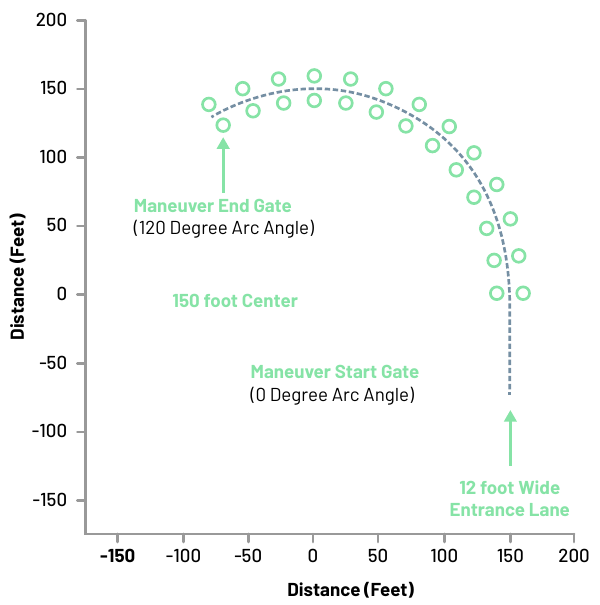
Test setup: TRC Ohio, 240 runs, 200 ft radius, empty/full payloads, outrigger-equipped 53-ft dry van trailer.
- Empty: +10% entry speed margin improvement (active system only); est. +15% total margin including the lower center of gravity.
- Loaded: +3.2% entry speed margin improvement (active system only); est. +6% total margin including the lower center of gravity.
The tested margin illustrates the advantage of active regenerative braking intervention by comparing system-on and system-off performance on an identical trailer. This proactive slowing occurs during the maneuver's critical initial phase. Furthermore, the eTrailer's lowered center of gravity contributes an additional 5.3% margin when empty and 3.1% when loaded compared to standard trailers.
Why a 3–6% margin matters: rollovers don't happen in the middle of the performance envelope — they happen at the margins. A small positive shift in vehicle capability can help prevent a disproportionate risk of rollover when compared to real-world incidents.
Double Lane Change: Evasive Maneuvers
Double lane change testing simulates emergency obstacle avoidance, which involves the most stressful seconds of any driver's career.
Test setup: TRC Ohio, 223 runs, 20–55 mph, all payloads. Watch the double lane change testing.
Testing showed a qualitative improvement in controllability. By diminishing the intensity of cab vibrations, the system reduces cognitive load for the driver, allowing for more effective handling during emergency maneuvers. Additionally, less trailer roll was observed on the rear of the trailer during maneuvers where the system was active, improving handling for the driver. Statistical comparison was limited by driver input variability between runs. Some test successes and failures were recorded at maximum test speeds both with and without the eTrailer active.
Analysis of test data across payloads and speeds demonstrated a measurable reduction in trailer roll compared to a baseline trailer. Roll angle was recorded by an IMU mounted at the rear of the trailer. This reduction is attributable to two mechanisms: the reduction in speed from the regenerative braking force applied by the eAxle, and the "squatting" behavior where the trailer sprung mass lowers under braking due to the suspension geometry.
Jackknife Prevention
Customers often ask whether the addition of a driven axle on a trailer could "push the tractor" and be a cause of a jackknife condition. The Range Energy eTrailer is specifically designed with key features to mitigate this risk:
- Tractor jackknife (tractor drive axles lose traction): the system inhibits drive torque when brakes are applied, and regen can pull back to reduce severity.
- Trailer swing (trailer axles lose traction): the system cuts torque immediately on wheel slip — a core traction control function.
The system monitors the same conditions that could cause instability and responds by reducing or reversing torque. Using our closed-loop control algorithms, the system avoids pushing blindly into an unstable situation.
Watch the eTrailer on ice: Range Energy J-Turn Comparison on Ice.
7. Precise Torque Control During Braking
Improved Stopping Distance
Electric motor torque can be modulated continuously with a much faster response time than conventional trailer air brakes, where ABS modulates pneumatic pressure in on/off cycles.
The eAxle's precise torque control keeps the tire in its optimal grip range, extracting more braking force from the available traction, which can improve stopping distance performance.
A secondary benefit is reduced variance. Stopping distance is inherently variable (surface, temperature, ABS valve on/off timing, tire condition, etc.), but precise torque control tightens the distribution of outcomes. Closing the gap between worst-case and best-case stopping performance is a key safety outcome, since the mitigation of extreme outliers is often more impactful for overall safety than simply boosting average results.
In accordance with industry standard testing practices, the stopping distances reported below are normalized to identical starting speeds, since minor deviations in initial speed have significant impacts on the overall stopping distance.
Dry Pavement Testing
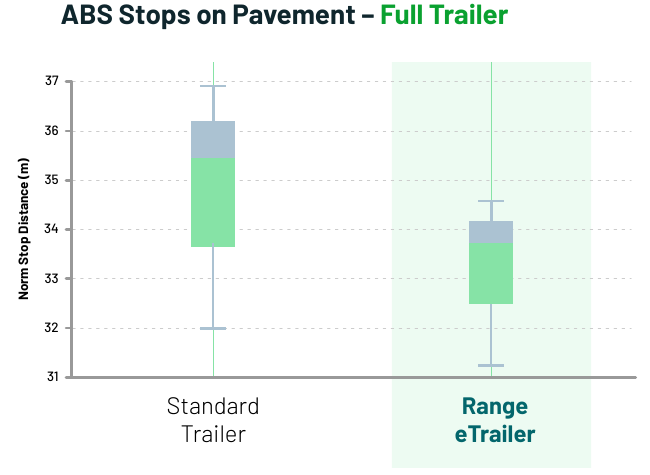
Test setup: TRC Ohio, 45 mph, 79,920 lb GCVW, dry pavement. Results from testing:
- 4–8% improvement in stopping distance.
- 1.5–3 meters (4.9–9.8 ft) shorter from an initial speed of 45 mph.
- 2.7–5.3 meters (8.9–17.4 ft) shorter from an initial speed of 60 mph (extrapolated).
Snow and Adverse Conditions
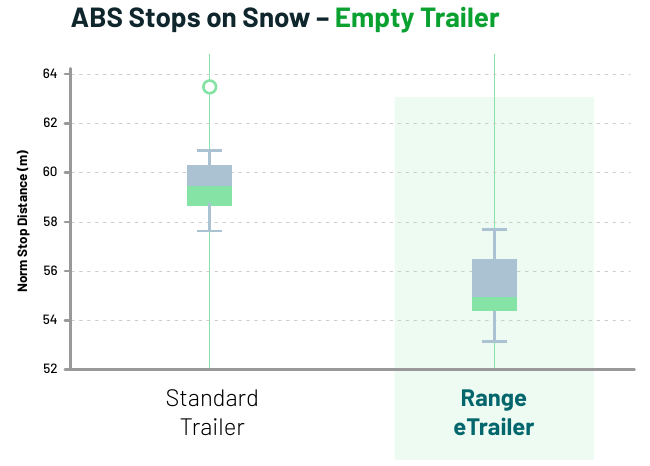
Test setup: Smithers Winter Test Center, 35 mph, 41,050 lb GCVW, packed snow.
For a lightly loaded (or empty) trailer on packed snow, the added control precision of the Range eTrailer's regenerative braking yields more substantial improvements over the baseline pneumatic braking, due to the maximization of the grip that the tires have to offer.
- 4–14% improvement in stopping distance (wide result based on surface variability).
- Methodology: alternating system-on/system-off runs, grouped by direction to control for slope and surface variation.
Tractor ADAS Compatibility
The eTrailer works cooperatively with modern tractor safety systems, and it does not interfere with or degrade their function.
- Braking — Automatic Emergency Braking (AEB), Adaptive Cruise Control (ACC), Active Speed Intervention (ASI): cooperative, as regen braking can assist.
- Steering — Lane Keep Assist (LKA), Lane Centering (LC): no impact, as the eTrailer has no steering actuation.
- Warning/monitoring — Forward Collision Warning, Lane Departure Warning, Blindspot Warning, Driver Monitoring, and Camera Mirror Systems: not applicable, as these are tractor-only systems.
ADAS reference: "Truck Operations' Guide to ADAS" — US DOT FMCSA.
The Range system enables real-time coordination with tractor systems through continuous data sampling and a 50 ms reaction time, all without requiring a direct data connection.
EBS System Compatibility
As brake technology improves, it is expected that truck Electronic Braking Systems (EBS) will begin entering the North American market. This type of braking system is already prevalent in the European market. In traditional braking systems, the driver's foot pedal directly controls the brake air pressure, which can then be modulated by the ABS system in the case of wheel slip. EBS adds an additional layer, where the EBS interprets the driver's foot pedal as a deceleration request, and then applies the correct air pressure to achieve that deceleration.
Range has conducted testing in coordination with industry brake suppliers, who are developing EBS systems for the North American market. This testing has demonstrated that the eTrailer System has no negative effect on EBS braking effectiveness, because the closed-loop control of the EBS system is fast enough to adjust for any additional deceleration contributions from the eTrailer regenerative braking.
Validation and Testing Partners
Range Energy has validated these safety benefits through extensive testing at industry-relevant proving grounds, in partnership with industry-leading suppliers:
- TRC Ohio (East Liberty, OH): J-turn, double lane change, stopping distance, outrigger testing.
- TRC Merced (Merced, CA): wet surface, traction control development.
- Smithers Winter Test Center (Sault Ste. Marie, MI): snow, ice, split-mu adverse condition validation.
- International Proving Grounds (New Carlisle, IN): durability, mechanical interface validation.
Test vehicle weights: empty 41,050 lb GCVW; half 60,770 lb; full 79,920 lb. J-turn radius: 200 ft (exceeds the FMVSS 136 standard of 150 ft).
Glossary
- ABS: Anti-lock Braking System.
- SSF: Static Stability Factor — ratio of track width to center of gravity height; standard rollover resistance metric.
- ROP: Active Roll Over Prevention — tractor-based stability intervention system.
- GCVW: Gross Combined Vehicle Weight.
- DLC: Double Lane Change — evasive maneuver test.
- J-turn: sustained high-speed corner maneuver simulating an off-ramp scenario.